ToasterBirb's Crackmes
One day upon opening crackmes.one I spotted a user who appeared to have uploaded their back catalogue of crackmes onto the site. Upon inspecting a few I realised that, although not difficult, they all were quite well made and taken as a whole they could be used as a good introduction to some of the many things you need to look out for as well as being a nice introduction to the different ways you can go about reverse engineering challenges.
The suggested way to approach these if you’re using them to learn is to have a go at them yourself until you get stuck, read a little bit until you can keep going rinse and repeat until you’ve solved it!
Many thanks to ToasterBirb for making the challenges!
| Name | Difficulty |
|---|---|
| No-standards | Easy |
| Seer | Easy |
| Jump | Easy |
| Flags | Easy |
| Interrupted | Medium |
| Box | Medium |
No-standards
Url https://crackmes.one/crackme/6736b3a09b533b4c22bd2b9f
Description

The programming standards have been entirely thrown out this time around. Literally.
Ignore all of the distractions and figure out the correct password. Patching is fine if it helps with the password recovery process. Good luck!
After a quick read of the disassembly we can see a function call to ptrace Clearly being used to prevent debugging (because the call fails if a debugger is already attached to the running process), patching it to always return 0 lets us connect our debugger.

Looking through the strings we see our win destination is reached when res is 0.
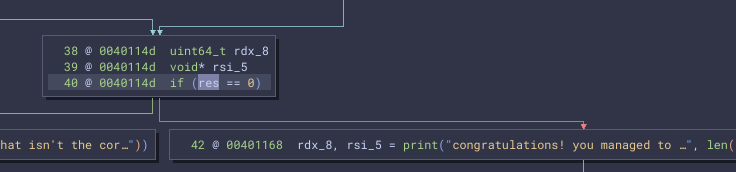
And after ignoring the bogus conditions that are unable to be called we find the two functions responsible for setting res.
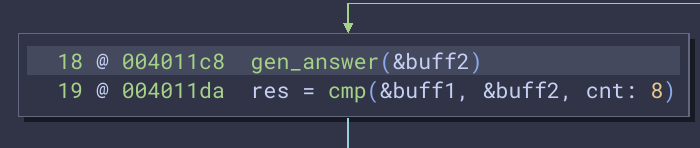
Now we can have a debugger we can set a breakpoint after the first function to find the “magical keycombination” and it seems to be good old :wq\n

Sure enough

Seer
Url https://crackmes.one/crackme/68691771aadb6eeafb398fb9
Description
Take your time or skip to the future. Your task is to figure out the magical passphrase. Patching is allowed (and encouraged (and required)).
Unsurprisingly this challenge requires patching and, given that it’s un-stripped, we can easily see the problem likely lies in the sleeps between slow_print
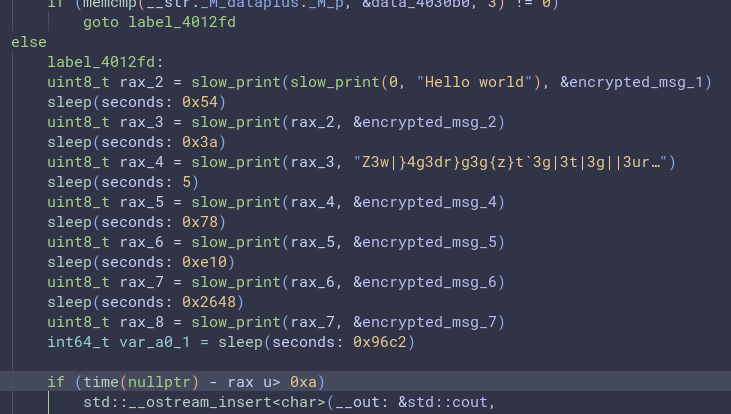
Going to the sleep definition within the .plt.sec and patching it to return instead of calling libc implementation we can cause the binary to run without stopping!
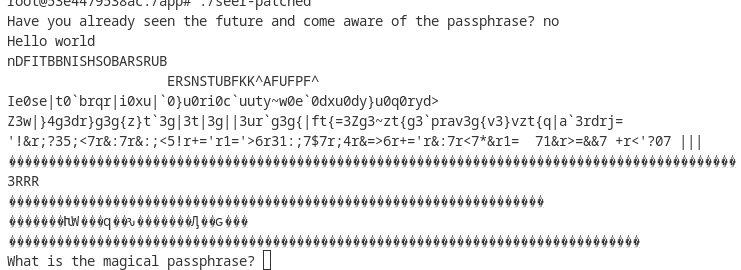
Although, upon closer inspection it appears the time difference is used to decrypt the strings.
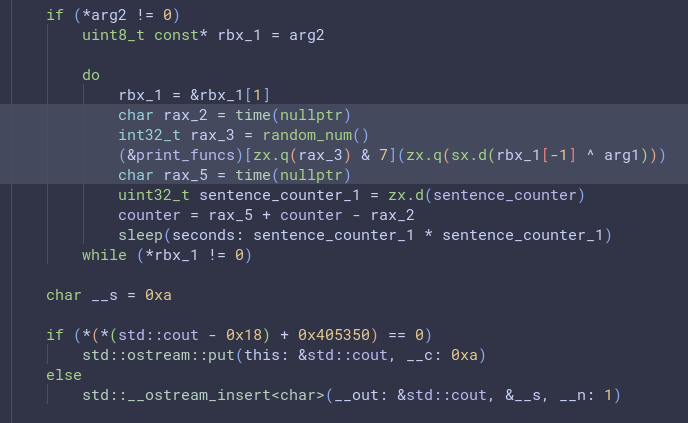
At this point we can do a couple things, the first and probably most sensible thing we could do is work out how slow_print works and create a binary ninja plugin that decrypts the strings using the time called to sleep. However, I’m lazy and I realised the xor key is only a byte long and there’s only 9 encrypted strings so we can just brute-force them all.
| # | Key | Decrypted String |
|---|---|---|
| 1 | 27 | I can see into the future, but its really far away… |
| 2 | 10 | You could probably help me by speeding up the time a bit |
| 3 | 13 | I don’t want things to go too fast though. It might scare the neighbors away. |
| 4 | 52 | Just imagine the things you could achieve if I told you the next correct lottery number… |
| 5 | e1 | Maybe you could buy me binoculars or something. You can see further away with those, right? |
| 6 | There’s a couple options for valid decodes, due to its length | |
| 7 | 93 | We could just cheat the system and teleport straight to the end somehow |
| 8 | f4 | Anyhow, I have one question for you. |
| 9 | 9f | And the correct answer to that question will be: I_HOPE_YOU_DID_NOT_JUST_WAIT_IT_OUT |
Well, there’s the password: I_HOPE_YOU_DID_NOT_JUST_WAIT_IT_OUT. Sure enough, plugging that into the program, we find we’ve solved the challenge.

Quick aside, I originally solved the challenge just using the brute force and not patching because I didn’t have a new enough glibcxx on hand to run it. So the authors description might need an update :)
Jump
Url https://crackmes.one/crackme/6869287daadb6eeafb398fec
Description:
That illegal instruction minefield looks a bit sketch. Can you jump into the middle of it without having anything blow up?
Upon opening the binary, I found it to be a hand crafted non-PIE binary with all its logic stored in _start followed by a block of 0x0f0b aka ud2 instructions broken up by two 0x90 aka NOP instructions and some other asm which appears to be the win function

Sure enough converting it into a function yields the final target, now we just need to find a way to jump to it.

However, turning back to _start, the binary appears to do nothing of note and never appears to make any jump we can control. This is why we need to read the ASM. I spotted that the rsp register was sneakily being modified to be 0x00401365 meaning that, when the program returned at the end of _start, it wouldn’t exit, instead it would unwind using the new stackpointer

Having a look at the new stack we see a few functions which each consist of a single instruction followed by a ret
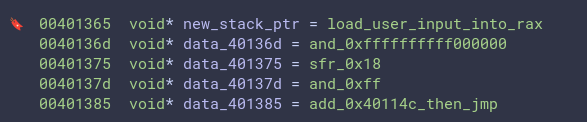
We can use these to determine the win function’s address is encoded with (win_address - 0x0040114c) << 0x18. Putting it together we get a final payload of:
from pwn import *
p = process("./jump")
p.recvuntil(b":")
p.send(p32((0x004011be - 0x0040114c) << 0x18))
p.interactive()
Flags
Url https://crackmes.one/crackme/686918c6aadb6eeafb398fbd
Description
I like flags. Some very specific types of flags. I also like keygens. I'd like to have a keygen
Given that this specifically asks for a keygen I thought it fitting to use it as an excuse to introduce the basics of angr (in addition to the fact that the binary messes up Binary Ninja’s auto analysis). After looking at the strings I found what appears to be the target Thanks, that's perfect!\n so I created an angr script to find a path to it.
import angr

proj = angr.Project("./flags", auto_load_libs=False)
state = proj.factory.entry_state()
simgr = proj.factory.simgr(state)

simgr.explore(find=lambda s: b"Thanks, that's perfect!\n" in s.posix.dumps(1))
if simgr.found:
    print(f"Found a solution:  0x{simgr.found[0].posix.dumps(0).hex()}")
else:
    print("No solution found.")
Interrupted
Url https://crackmes.one/crackme/686927e0aadb6eeafb398fe7
Description:
How does one interrupt themselves? Figure out a working password!
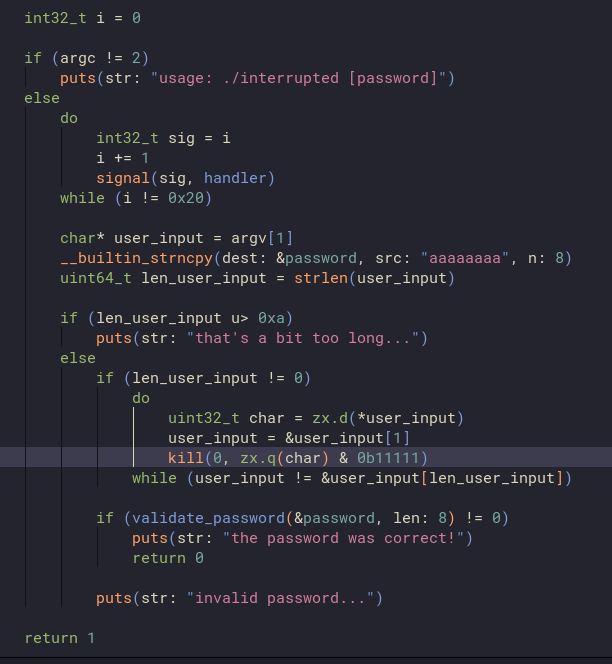
A quick inspection of the main function shows us it maps a handler to all possible signal interrupts and then invokes kill (using pid 0 on kill causes it to invoke the provided interupt against all the process in its group) using each char in the users input as the signal to send.
Looking at the signal handler we see it just indexes into the final password using the signal % 8, and then sets the aforementioned index to the signals position in the lowercase alphabet. It should be noted though, that it has a well hidden (possibly intended) bug being that signal cannot catch SIGKILL and SIGSTOP meaning any solver needs to avoid inputs that generate them.

Checking how the password is validated we see it just requires that the processed password doesnt include any a’s (the default state of the processed password) and that each char isnt followed by a char numericly one less than it
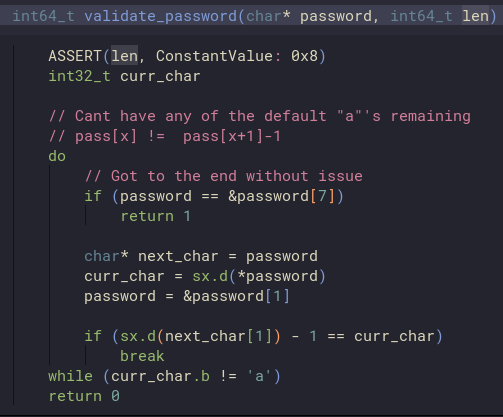
Given its a 7 char password it seems trivial to use angr to find a solution. However, the binary has broken sections preventing angr from being able to run it. Although It’d be possible to faff around with the binary to fix it, I decided against it for fear of angr not playing nice with the signal interrupts.
Instead I opted to translate the logic into the z3 SAT solver. I broke the programs conditions into into three main blocks (for notation I used shadow to mean the password that is modified and validated, and password to mean the original user input):
- Indexing: Every position in the shadow should be updated to something other than
aby a char in the original password - Valid inputs:
- For simplicity I restricted the password to only alphabetic chars
- An inputed char shouldn’t generate a
SIGKILLorSIGSTOP - No
a’s should be put into the shadow by the password
- Ordering of the Shadow: Each position in the shadow should’nt be followed by a char that is one less than it
The first two were fairly trivial to implement
def valid_chars(password:List[BitVecRef]) -> BoolRef:
    modify = lambda x: ((x & 0b11111) % 0x1a) + 0x61
    is_alpha = lambda x: Or(And(x >= 0x61, x <= 0x7a), And(x >= 0x41, x <= 0x5a))
    is_catchable = lambda x: And((x & 0b1_1111) != 9, (x & 0b1_1111) != 19)

    constraints = [modify(password[i]) != 0 for i in range(LENGTH)]
    for i in range(LENGTH):
        constraints.append(is_alpha(password[i]))
        constraints.append(is_catchable(password[i]))
    return And(constraints)

def all_indexes_filled(password: List[BitVecRef]) -> BoolRef:
    cons = [Or([(password[j] & 0xF) == i for j in range(LENGTH)]) for i in range(LENGTH)]
    return And(cons)
However the ordering of the shadow was more complex given it at first glance requires sorting the password values using & 0b1_1111. However instead you can use implications, so by finding the possible indexes of each password in the shadow we can brute force the ordering
def valid_order(password: List[BitVecRef]) -> BoolRef:
    modify = lambda x: ((x & 0b11111) % 0x1a) + 0x61
    indices = [password[i] & 0b111 for i in range(LENGTH)]
    constraints = [
        Implies(
            And(indices[i] == idx, indices[j] == idx + 1),
            modify(password[i]) != (modify(password[j]) - 1)
        )
        for idx in range(LENGTH - 1)
        for i in range(LENGTH)
        for j in range(LENGTH)
    ]
    return And(constraints)
putting it all to gether we get the following code (see the full code)
note that we use length to be 8 to prevent the solver breaking when tying to deal with characters in the password that would overwrite an already modified char in the shadow
LENGTH = 0x8
answer = [BitVec(f'c{i}', 8) for i in range(LENGTH)]
s = Solver()

s.add(all_indexes_filled(answer))
s.add(valid_chars(answer))
s.add(valid_order(answer))

if s.check() == sat:
    m = s.model()
    result = [m[answer[i]].as_long() for i in range(LENGTH)]
    print("".join([chr(x) for x in result]))
to give us a finished solve script
$ ./interrupted $(python solve.py)
the password was correct!
Box
Url https://crackmes.one/crackme/686919d4aadb6eeafb398fc1
Description:
What does the box do and why doesn't it like my keys? Which key do I need to give to it to make it happy?
Starting by running the binary we see the following prompt
$ ./box
     +----█
     |
     v
Putting pretty much anything in as our input, we get the following:
$ ./box
     +---- aaaaa
     |
\/\/\/\/\/\
     |
     +---> The box deems your key either too short or too long
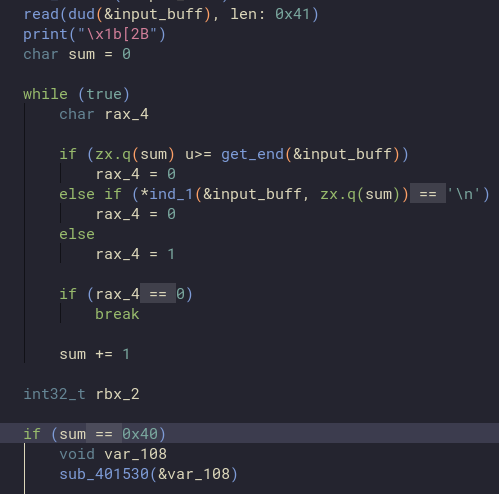
Deciding its time to open the binary, and naming some obvious functions, we see the following loop and check suggeting a required key length of 0x40
Plugging in a key of length 0x40, we see the following
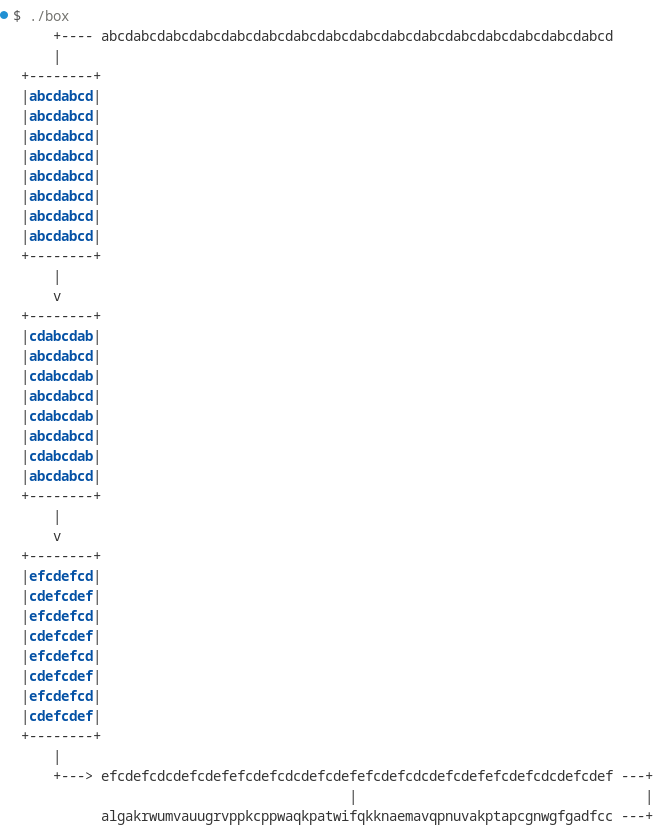
Clearly, the programs deividing the key into a grid, and applying two transforms finally looking for a key of algakrwumvauugrvppkcppwaqkpatwifqkknaemavqpnuvakptapcgnwgfgadfcc
The last transform is easy to guess, as it’s just an adding two to each char, so reversing that we get _je_ipuskt_sseptnniannu_oin_rugdoiil_ck_tonlst_inr_naeluede_bdaa as our new target key
A side tangent
When reversing originally I nievely assumed the first transform was independent of the inputed key and so i attempted to skip doing any more reverse engineering and instead created a mapping function. I correctly spotted that each pair of two rows was independent of one another and so I sent 0-f through the program and took the tranformed data and decoded it’s mappings
mappings = {"b23dafce89014567".find(c): i for i, c in enumerate("0123456789abcdef")}

answer = [0x00 for _ in range(0x40)]

for i, c in enumerate(map(lambda x: x - 2, map(ord, "algakrwumvauugrvppkcppwaqkpatwifqkknaemavqpnuvakptapcgnwgfgadfcc"))):
    answer[((i // 16) * 16 )+ mappings[i % 16]] = c
print("".join(map(chr, answer)))
Sadly however it wasn’t that easy with the “solve” giving a garbage output of _sjeseptkti_u_spn_nirugdoinnua_nnliist_ito_okl_ce_r_bdaaedanlnue Which, although wrong, does show us that some of the transformation is dependent on the input data, and we shouldn’t always try take the easy way out before more testing
Back on track
After stepping through the code dynamiclly I found the function responsible for the first transform shown to the user; It appears to have 5 differnt transforms it uses, and a few checks dependent on the eveness of parts of the data, along with specific functions for indexing into the grid
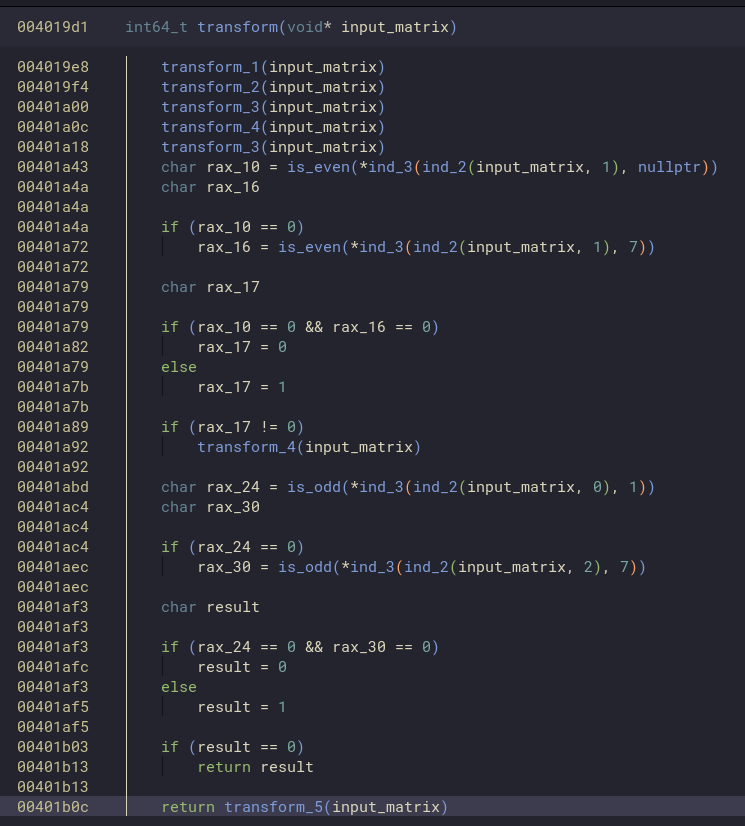
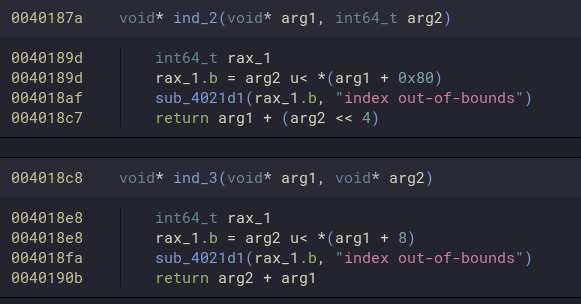
Looking at the index functions we can assume (because the grid is 8x8) and the left shift by 4 ind_2 is indexing by row and inx_3 is indexing within a row
Using this we can simplfy the even and oddness checks to be equivalent of
if grid[0][1] % 2 != 0 or grid[0][7] % 2 != 0:
    transform_4(grid)

if grid[1][0] % 2 == 0 or grid[1][7] % 2 == 0:
    transform_5(grid)
Meaning all we have to do is work out what the rest of the functions do. Now only using static analysis would take far more time than I’d like so instead I opted to use time travel debugging to visually see the transformation in memory while stepping backwards and forwards through the binary (This time I carefully watched for any hidden conditionals)
Starting with the initial state in memory
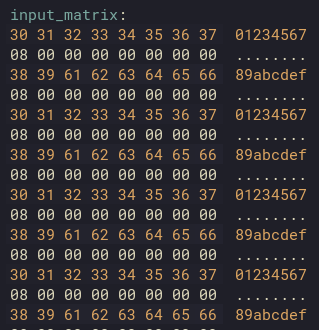
We then run transform_1 revealing that it swaps every second row with the one below itself

Next transform_2 swaps each pair of bytes around
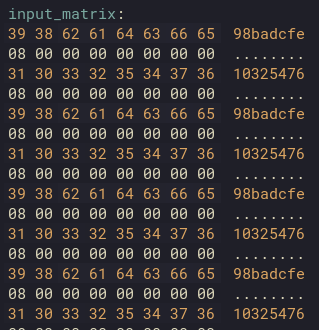
Then transform_3 swaps every second byte in every second row with the one down and to its right
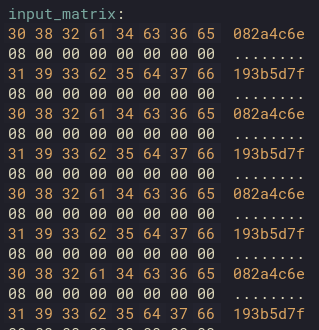
Next we get to the first call to transform_(4|5) both of which’s behaviour is dependent on if something is even or odd respectively. All it is doing is summing the value of an item in the matrix and the one to its right and if its even/odd then swapping the variables
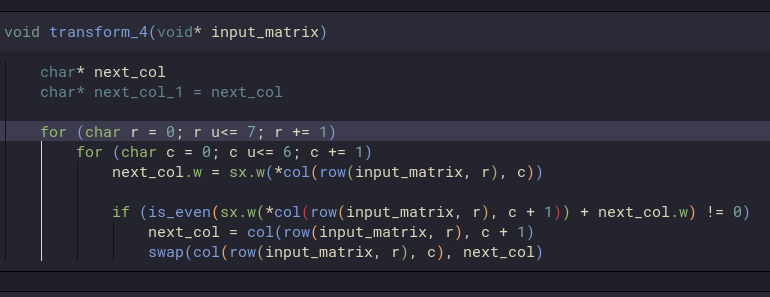
and with that we are now able to implement the mixing algorithm in python to check if our understanding and dynamic analysis was correct click here to see the code. Sure enough our python implementation manages to create the same outputs as the binary, so all we have to do now is write the inverse and tada we’ve got the key
$ python solve.py
a l g a k r w u
m v a u u g r v
p p k c p p w a
q k p a t w i f
q k k n a e m a
v q p n u v a k
p t a p c g n w
g f g a d f c c

i t _ j u s t _
k e e p s _ s p
i n n i n g _ a
r o u n d _ u n
t i l _ i t _ l
o o k s _ n i c
e _ a n d _ u n
r e a d a b l e

it_just_keeps_spinning_around_until_it_looks_nice_and_unreadable